Cost of Living in Charlottesville, VA: 2026 Guide
You can live five miles from someone else in Charlottesville, have almost the exact same lifestyle, and spend dramatically different amounts on your house, property taxes, HOA fees, and even everyday expenses. That's the thing about moving to Charlottesville VA, it's not one housing market with one cost of living number. It's a patchwork of small cities, county neighborhoods, and rural communities that all answer to the name Charlottesville, but they don't all answer to the same budget.
I'm breaking down exactly what it costs to live in the Charlottesville area in 2026: housing, taxes, utilities, transportation, food, healthcare, entertainment, and several expenses people moving here almost never think about. Because when someone Googles cost of living in Charlottesville and gets one number from a national website, they're missing the entire picture. Let me show you what that picture actually looks like.
Table of Contents
- City of Charlottesville: Walkable Living at a Premium
- Albemarle County: More Space, Lower Taxes
- Crozet: Established Community in the $600k, $800k Range
- Forest Lakes: Neighborhood Living in Albemarle
- Hollymead: Another Albemarle Option
- Greene County: Lower Cost, Longer Commute
- Which Area Is Right for You: Trading Off Taxes, Commute, and Space
- Conclusion: Your Budget Depends on How You Want to Live
City of Charlottesville: Walkable Living at a Premium
The City of Charlottesville itself is very small, under 10 square miles, and it has the highest taxes and the highest median home prices in the area. But here's what you get for that premium: walkability, the Downtown Mall, Belmont, West Main, a real dining scene, entertainment, cultural amenities, and CAT free transit. You can live without a car in certain parts of the city. That's rare for central Virginia.
Property taxes in the city run $0.99 per $100 of assessed value. So if your home is assessed at $500,000, you're looking at approximately $4,950 a year in property taxes. A $750,000 assessment puts you just over $7,400 annually. And remember, we're talking assessed value, not what you paid or what the seller's last assessment was. Your assessment comes out January 1st and is valid for the whole year. Most of us pay property taxes with our mortgage payment, but it's paid in two chunks, one in early June, one in early December.
Now, what does $500,000 actually buy you in the City of Charlottesville? Don't automatically assume you're getting a big detached house with a huge yard five minutes from downtown. Depending on location, $500,000 might mean a new construction townhome, a smaller or older detached home, or something close to downtown but not what you'd call spacious. You move further out and that same budget gives you considerably more house, more land, or both.
There's also a 7% local meals tax on restaurant food in the city, on top of the 5.3% Virginia retail sales tax. So that $100 dinner turns into $112 before you even add the tip. That's a legitimate cost of living expense if you like eating out, and Charlottesville loves to eat out. We're known for fabulous food, whether it's a taco truck or a Michelin-star vineyard dinner.
Parking downtown is fairly manageable compared to major metros. At the City Market Street and Water Street garages, the first hour is free, then it's a dollar per half hour with a $12 maximum. If you're coming from Northern Virginia, DC, or New York, that's going to feel like a bargain. The city also has natural gas utility available, which is a City of Charlottesville utility. Most areas outside the city don't have that option.
The trade-off is space and taxes. You're paying more per square foot and more in annual property taxes than you would just outside the city line. But if walkability and being in the center of things matters to you, the City of Charlottesville delivers.
Albemarle County: More Space, Lower Taxes
Albemarle County completely surrounds the City of Charlottesville, and it's where your housing dollar starts to stretch. The property tax rate drops to $0.894 per $100 of assessed value. That same $500,000 home now costs you just under $4,470 a year in property taxes instead of $4,950. It's not a huge difference on paper, but it adds up over time, and the housing stock changes dramatically.
In Albemarle County, $500,000 to $800,000 opens up newer construction, established neighborhoods, and larger detached homes. You've got communities like Crozet, Earlysville, Ivy, Keswick, Scottsville, Forest Lakes, Hollymead, and Old Trail. New construction communities include North Pointe, Dunlora Village, Glenbrook, and Southwood. But here's the thing about new construction: do not just compare base prices. You have to factor in lot premiums, structural upgrades, design center upgrades, and potential HOA fees. That $600,000 advertised home can become a very different number by the time you build the home you actually want.
Once you get into the $900,000 and above range, we're talking about the largest homes, acreage, premium locations, and luxury communities. But even at that price point, location matters enormously. A million-dollar home in Ivy doesn't buy what a million dollars further out on Route 29 does, and a million dollars in Charlottesville doesn't buy you a million dollars in Waynesboro. Different products, different lifestyles.
Albemarle County has top-notch public schools, and CAT transit has some access points, but it's not practical for a daily commute in most areas. You're going to need a car. The trade-off is more space for your money and lower property taxes, but you lose the walkability and immediate access to downtown that the city offers.
Crozet: Established Community in the $600k, $800k Range
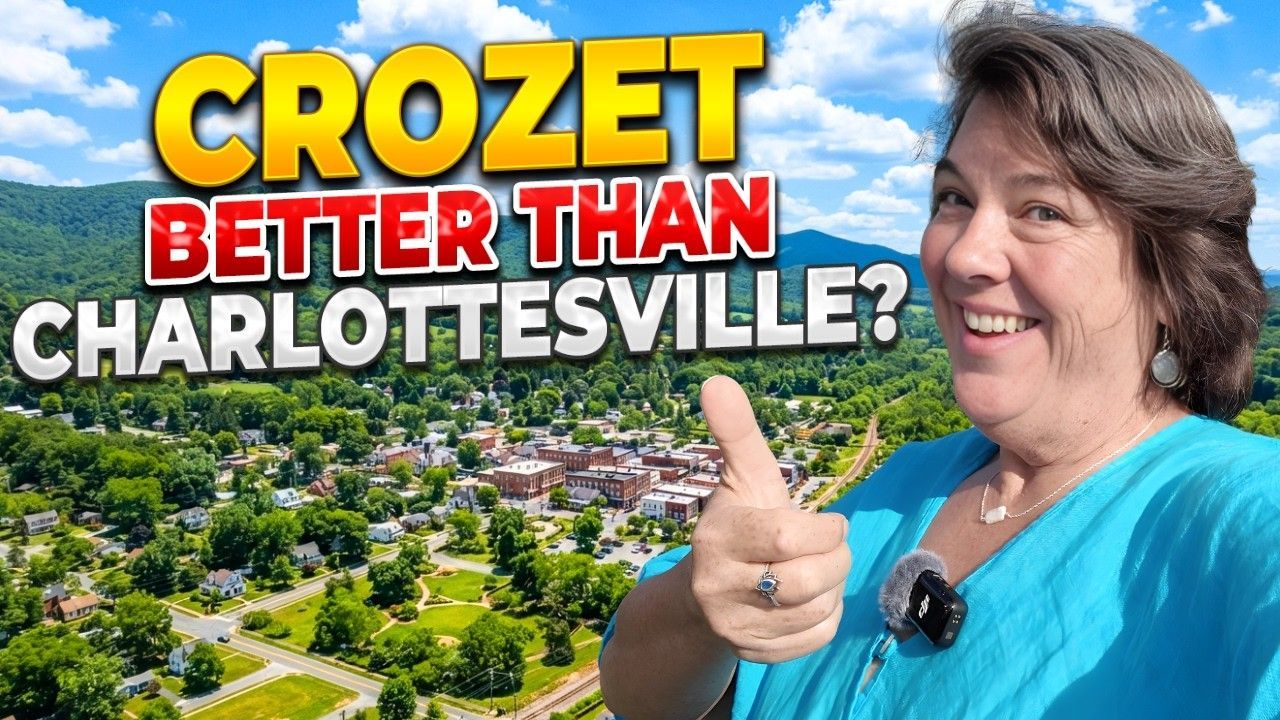
Crozet is part of Albemarle County, so you're looking at that $0.894 per $100 property tax rate. In the $600,000 to $800,000 range, Crozet gives you an established community feel with access to schools, shopping, and a bit of small-town charm. It's far enough from the city to feel like you're not in the thick of things, but close enough that the commute isn't punishing.
Crozet is one of those places people mention when they want something other than city living but don't want to be completely rural. It's a middle ground, and that $600k, $800k range reflects that.
Forest Lakes: Neighborhood Living in Albemarle
Forest Lakes is an established neighborhood in Albemarle County, also in that $600,000 to $800,000 range. It's the kind of place people think of when they want a neighborhood with amenities, a sense of community, and proximity to Charlottesville without being in the city itself. You're still under the Albemarle County tax rate, and you're getting more house than you would in the city for the same money.
Hollymead: Another Albemarle Option
Hollymead is another Albemarle County neighborhood that falls into the $600,000 to $800,000 range. It's one of several communities people consider when they want newer construction or a planned neighborhood feel without going all the way out to Greene or Fluvanna. You're still close enough to Charlottesville to make the commute work, and you're getting Albemarle County schools and that lower property tax rate.
Greene County: Lower Cost, Longer Commute
Greene County is further outside Albemarle County, and that's where your money goes further, but you're adding commute time and mileage. Greene has a different property tax rate than Albemarle, and it's getting its first Publix, which tells you something about how the area is growing. Greene County also has top-notch public schools, but CAT transit access is limited. You'll need to check routes if you're hoping to rely on public transit.
The trade-off is straightforward: lower cost, longer commute. If you're working remotely or your job isn't in Charlottesville proper, Greene can make a lot of sense. But if you're driving into the city five or six days a week, you need to factor in gas, maintenance, mileage, tires, and most importantly, time. Saving $300 a month on housing and adding hundreds of miles to your commute may not be the bargain you think it is.
Which Area Is Right for You: Trading Off Taxes, Commute, and Space
So how do you choose between the City of Charlottesville, Albemarle County, and places like Greene? It comes down to what you're willing to trade.
Choose the City of Charlottesville if you want walkability, you want to be in the center of the dining and entertainment scene, and you're okay paying higher property taxes and higher home prices for that lifestyle. You can live without a car in certain parts of the city, and that's worth something.
Choose Albemarle County if you want more space for your money, lower property taxes, and access to top-notch schools, but you're okay needing a car for most errands. Communities like Crozet, Forest Lakes, and Hollymead give you that suburban or small-town feel without being too far from the city.
Choose Greene County or further out if your priority is getting the most house and land for your budget, and you're okay with a longer commute or you work remotely. Your money goes further, but you're adding time and mileage to your daily routine.
Moving just a few miles can dramatically change your housing costs, property taxes, and HOA fees. A $500,000 home in the City of Charlottesville versus Albemarle County versus Greene or Fluvanna buys you completely different properties. And a million-dollar home in Ivy versus further out on Route 29 versus Waynesboro are completely different products.
The other thing to consider: saving money on housing further out may cost you more in commute time, gas, maintenance, and quality of life. I've had people tell me they're good with a commute up to an hour, and I think, why are you going to spend that much time in the car? Our average commute is 15 minutes. If you really want to commute up to an hour, we can make it happen, but that's your choice, not my recommendation.
Conclusion: Your Budget Depends on How You Want to Live
So is Charlottesville expensive? Compared to some areas around Virginia, absolutely. Housing is the biggest reason. But compared to Washington DC, Northern Virginia, New York, Boston, California, and some other places people relocate here from, the answer becomes much more nuanced.
Because Charlottesville gives you something. We're an anomaly. You live in a small city with UVA, major healthcare, fabulous restaurants, wineries, arts, college sports, and a real downtown. You drive 15 to 20 minutes and you're surrounded by mountains and countryside. You can have completely different budgets and completely different lifestyles depending on whether you're living in a townhome in Belmont, a new construction home in Crozet, three acres in Earlysville, or out in Lake Monticello or Waynesboro.
When somebody asks me how much money they need to live in Charlottesville, my answer is: tell me how you want to live, because that is the number that actually matters. If you're trying to decide whether you should live in Charlottesville or whether one of the surrounding communities would give you a better lifestyle, let's talk. Call or text me at (434) 218-3142. I've grown up here, I know these communities, and I can help you figure out where your budget actually works for the life you want to live. Reach out before you register with a builder or fall in love with a house online. Let me show you what your money actually buys in each of these areas.
FAQ
What is the property tax rate in Charlottesville VA?
The City of Charlottesville property tax rate is $0.99 per $100 of assessed value, which works out to approximately $4,950 a year on a $500,000 assessed home. Albemarle County's rate is $0.894 per $100, or about $4,470 a year on that same $500,000 assessment. Property taxes are paid in two chunks, early June and early December.
Does Virginia have personal property tax on cars?
Yes. Virginia will send you a bill for owning your car, even if you're still paying on it. In Albemarle County, the 2026 personal property tax rate is $4.28 per $100 of assessed value. This applies to vehicles, trailers, motorcycles, trucks, and motorhomes. Virginia's personal property tax relief can affect what qualifies, but if you're moving here with multiple newer vehicles, budget for it.
What does $500,000 buy in Charlottesville?
In the City of Charlottesville, $500,000 might buy you a new construction townhome, a smaller or older detached home, or something close to downtown but not spacious. In Albemarle County, that same $500,000 to $800,000 range opens up newer construction, established neighborhoods, and larger detached homes in communities like Crozet, Forest Lakes, and Hollymead. Move further out to Greene or Fluvanna and your money goes even further.
Is there a meals tax in Charlottesville?
Yes. Prepared meals in the City of Charlottesville have a 7% local meals tax on top of the 5.3% Virginia retail sales tax. So a $100 restaurant bill becomes $112 before tip. If you like eating out, that's a real cost of living expense.
Do I need a car to live in Charlottesville?
In certain parts of the City of Charlottesville, especially near the Downtown Mall, Belmont, and West Main, you can live without a car. CAT transit is free, but coverage is limited. In Albemarle County and further out, you're going to need at least one car, if not two. Most people around Charlottesville still drive.
How much does home insurance cost in Charlottesville VA?
Home insurance in Charlottesville is much lower than Florida, coastal areas, California, or the Northeast because we don't require hurricane, wildfire, or tornado insurance. Your premium depends on the home itself, replacement value, age of the roof, claim history, and coverage. For reference, my home is assessed around $500,000, and after I replaced my roof, my insurance runs about $1,600 a year, roughly $150 added to my monthly mortgage payment.
living in charlottesville
Pam Whorley is a dedicated REALTOR® who has lived and grown up in Charlottesville, bringing her extensive local knowledge and passion for the area to help clients find their perfect home. Whether you're buying, selling, or relocating, Pam’s personalized approach ensures a smooth and stress-free experience.